
AI Sermon Transcription: Capture Every Word of Sunday
Most of what you hear on Sunday is gone by Tuesday — not because you weren't listening, but because listening and note-taking fight for the same attention.
By Oleh · Maker of Sacred Hour

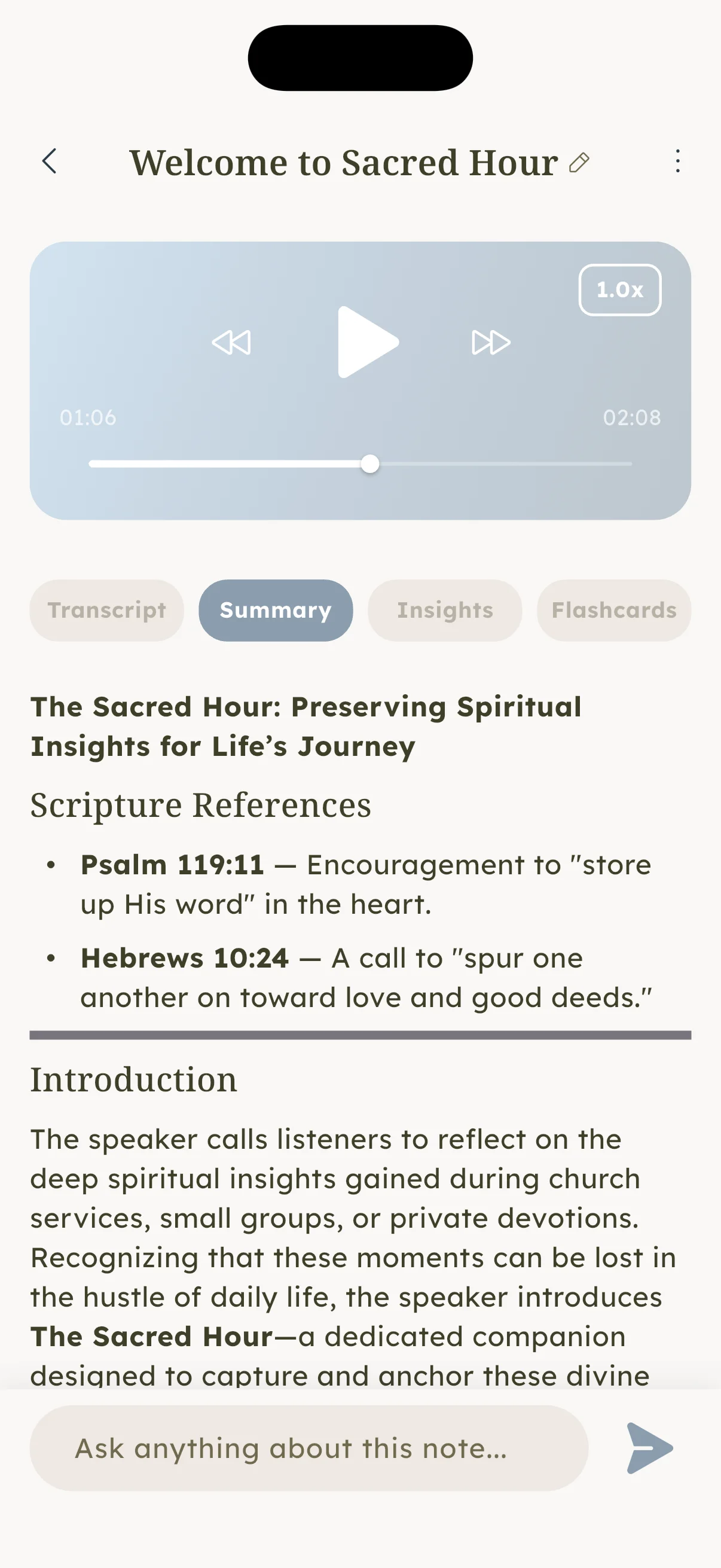
AI sermon transcription records the sermon on your phone and turns it into an accurate text transcript, then a short summary and a set of flashcards you can review during the week. In Sacred Hour it runs the whole chain — record or scan, transcribe, summarize, and study — so the teaching survives past Sunday lunch instead of fading by Tuesday. You listen fully in the moment; the capture happens for you.
You walk out of a sermon that genuinely moved you. By Wednesday, you can maybe name the passage. By the weekend, even that's fuzzy. This isn't a you problem — it's how memory works, and it's exactly the gap this feature is built to close.
Why Sunday fades so fast
Hermann Ebbinghaus mapped this back in 1885, and modern replications have held up his numbers. Without any review, people forget roughly two-thirds of new material within 24 hours. A week out, only about a quarter survives. A sermon is 30 to 40 minutes of dense, unfamiliar material delivered once — close to the worst-case scenario for retention.
Handwritten notes help, but they come with a hidden tax. Every second you spend writing is a second you're not fully hearing. You're transcribing the last sentence while the next point sails past. That's the quiet trade every note-taker makes, week after week.
The seed on good soil stands for those with a noble and good heart, who hear the word, retain it, and by persevering produce a crop.
— Luke 8:15
Retaining it is the part the verse names — and the part our phones usually sabotage.
What AI sermon transcription actually does
The idea is simple. Your phone records the audio. Software converts speech to text, and from that text you can generate a summary and study material. You stop being a stenographer and go back to being a listener.
Sacred Hour runs this as one connected flow rather than four disconnected apps:
- Capture → record the sermon live, or scan a printed outline or your own scribbled page.
- Transcribe → the audio becomes searchable text you can scroll, copy, or revisit.
- Summarize → a condensed version pulls out the main points and the passages referenced.
- Study → the summary turns into flashcards, so review takes minutes, not a re-listen.
The point isn't the transcript sitting in your files. It's what the transcript lets you do afterward — search a phrase you half-remember, reread the argument slowly, and quiz yourself on Thursday when the sermon has already started slipping.
Recording everything vs. writing by hand
Here's the honest comparison, without pretending one wins on every line:
| Handwriting notes | AI transcription | |
|---|---|---|
| Attention during the sermon | Split between listening and writing | Fully on listening |
| What you leave with | Your filtered highlights | Full text + summary + flashcards |
| Catching an exact quote | Only if you wrote fast enough | Always — it's all captured |
| Effort to review later | Reread your own shorthand | Flashcards, ready-made |
| Personal engagement | High — writing forces processing | Lower in the moment, higher after |
Notice that last row. Writing by hand does something real — the act of choosing what to record makes you process it. So the strongest approach usually isn't picking a side. Record everything so nothing's lost, and still jot a few words when a point lands hard. The transcript is your safety net; your handwriting is your engagement.
Where a transcript earns its keep
A few moments where this stops being a nice-to-have:
- The pastor quotes a verse you don't catch the reference for. Search the transcript later instead of guessing.
- A line hits you but you can't write fast enough to keep it. It's captured word for word, waiting.
- You lead a small group Wednesday and want to build discussion from Sunday's teaching — the summary is your starting outline.
- You missed a Sunday. A recording someone shares becomes a full, studyable text, not just 40 minutes you have to find time to re-listen to.
- Months later, a topic comes up and you remember your pastor preached on it — searchable text turns "I think he said something about this" into the actual passage.
Stop losing the sermon by Tuesday
Sacred Hour records, transcribes, summarizes, and turns Sunday's teaching into flashcards — so you can listen fully and still keep every word.



A word on doing this respectfully
Two things worth naming. First, record with permission — many churches are fine with it, but ask, especially if you'll share the audio. Second, a transcript is a tool, not a replacement for sitting under the teaching. The goal isn't to outsource your attention to software. It's the opposite: to free your attention during the sermon by trusting the capture to happen without you.
Common questions
Is AI sermon transcription accurate enough to trust?
Modern speech-to-text handles clear sermon audio well, and the full transcript plus summary gives you more than hurried handwriting usually does. It's not flawless — proper names, uncommon theological terms, and heavy accents can trip it up — so treat the transcript as a strong first draft you can correct, not an infallible record.
Does recording the sermon mean I should stop taking notes?
No — and that's the surprise. Writing by hand forces you to process what you hear, which aids memory in a way passive capture doesn't. The best pattern is both: let the app capture everything so nothing's lost, and still jot the few points that hit you personally.
Can I use this if I only have a printed outline or my own handwritten notes?
Yes. Sacred Hour lets you scan a printed sermon outline or your own written page, not just record live audio — so the summary-and-flashcards flow works even for services you couldn't record.
What do I actually do with the transcript during the week?
Review the summary, run the flashcards a couple of times, and search the full text when you're trying to recall a specific point. That spaced review is exactly what flattens the forgetting curve Ebbinghaus mapped — a few minutes on Tuesday and Thursday keeps far more of Sunday alive than a single Sunday-afternoon reread.
What to do now
Pick this coming Sunday. Ask permission, set your phone to record, and then just listen — no scrambling to write down every point. Afterward, read the summary once and run the flashcards midweek. You're not trying to capture the sermon perfectly. You're trying to still have it on Thursday, when it's already started to fade.


