
Free Sermon Note Template — 3 Methods (Plus a Printable)
Most sermon note templates hand you a box labelled "Notes" and call it a system — here are three that actually decide something for you before the preaching starts.
By Oleh · Maker of Sacred Hour

A sermon note template works by deciding, before the sermon starts, where each kind of information goes — so you spend the hour listening instead of choosing a format. Three cover almost everyone: the two-column template (the Cornell method, adapted for church), SOAP (when the sermon sits on one passage), and a one-line template for weeks when you're barely holding it together. Copy or print the one that fits, and use the same one for a month before you judge it.
Search "sermon note template" and you'll get four hundred versions of the same page. A line for the date. A line for the passage. A line for the preacher's name. And then a large empty rectangle helpfully labelled Notes.
That rectangle is the whole problem. It's the blank page you already had, with a border drawn around it.
A template is supposed to make decisions for you in advance. The generic one makes the three easy decisions — date, passage, title — and leaves the only hard decision, what is actually worth writing down, entirely to you. Mid-sermon. While someone is still talking. Which is precisely when you're least equipped to make it.
Below are three templates that make the hard decision instead. They're plain text so you can paste them into any notes app or print them on anything.
Why the box marked "Notes" does nothing for you
Constraint is the feature. A small box for the big idea forces you to decide what the big idea is. A big box invites you to transcribe, and transcription is the one habit that reliably prevents a sermon from sticking — your hand keeps up, so your brain never has to summarize, and summarizing is where memory gets made. (I dug into the research behind that in how to take sermon notes that actually stick.)
There's also a reason there are three templates here and not one. Sermons aren't uniform. A verse-by-verse walk through Romans 8 wants a different container than a topical message that touches six books in forty minutes. And some Sundays you're sharp; some Sundays you were up at 3am with a sick kid and "one line" is the honest ceiling.
The pattern is old:
They read from the book, from the Law of God, clearly, and they gave the sense, so that the people understood the reading.
— Nehemiah 8:8
Giving the sense. Not the transcript. That's the job your notes are supposed to do for you on Wednesday.
Method 1 — The two-column sermon note template
This is the Cornell method, adapted. Walter Pauk, an education professor at Cornell, devised it in the 1950s and published it in How to Study in College in 1962; it's still in print eleven editions later, which tells you something.
Split the page into three zones: a narrow left column, a wide right column, and a strip across the bottom.
- Right column (wide) → during the sermon. What's being said, in your words. Rephrased, never copied.
- Left column (narrow) → after. Cue words and the questions your notes answer. Leave it empty in the service.
- Bottom strip → your own two-sentence summary, plus the one thing you'll do about it.
Here's what makes it the best all-rounder for church specifically: it has a second pass built into the layout. Two thirds of the page are physically blank when the service ends, which nags at you in a useful way. Most templates finish when the preaching finishes. This one doesn't let you.
Date: __________  Passage: __________  Title: __________

┌──────────────┬────────────────────────────────────────┐
│ CUES         │ NOTES (during — in your own words)     │
│ (fill in     │                                        │
│  after)      │                                        │
│              │                                        │
│ ____________ │ ______________________________________ │
│ ____________ │ ______________________________________ │
│ ____________ │ ______________________________________ │
│ ____________ │ ______________________________________ │
│ ____________ │ ______________________________________ │
└──────────────┴────────────────────────────────────────┘

SUMMARY (2 sentences, later today):
_________________________________________________________

MY ONE ACTION this week:
_________________________________________________________
Method 2 — SOAP, for sermons that stay in one passage
Scripture, Observation, Application, Prayer. The acronym was popularised by Pastor Wayne Cordeiro of New Hope Christian Fellowship in Honolulu, who laid it out in his 2007 book The Divine Mentor. It was designed for personal devotions rather than the pew — which is exactly why it works when your preacher is walking verse by verse through a single text.
What it does better than anything else: it refuses to let you stop at "that was a good point." Application isn't an optional box at the bottom, it's a quarter of the page. And ending in prayer turns note-taking from an academic exercise into something closer to a response.
Where it falls apart: a topical sermon that ricochets between Isaiah, Luke and James. SOAP's single Scripture slot will fight you the whole way. Use the two-column template on those weeks.
S — SCRIPTURE (write the verse out by hand, don't just cite it)
_________________________________________________________
_________________________________________________________

O — OBSERVATION (what does it actually say? who's speaking, to whom?)
_________________________________________________________
_________________________________________________________

A — APPLICATION (what does this ask of me, specifically, this week?)
_________________________________________________________
_________________________________________________________

P — PRAYER (write it, don't just think it)
_________________________________________________________
Writing the verse out longhand is not busywork — it's the slowest, most deliberate reading you'll give it all week.
Stop choosing between listening and writing
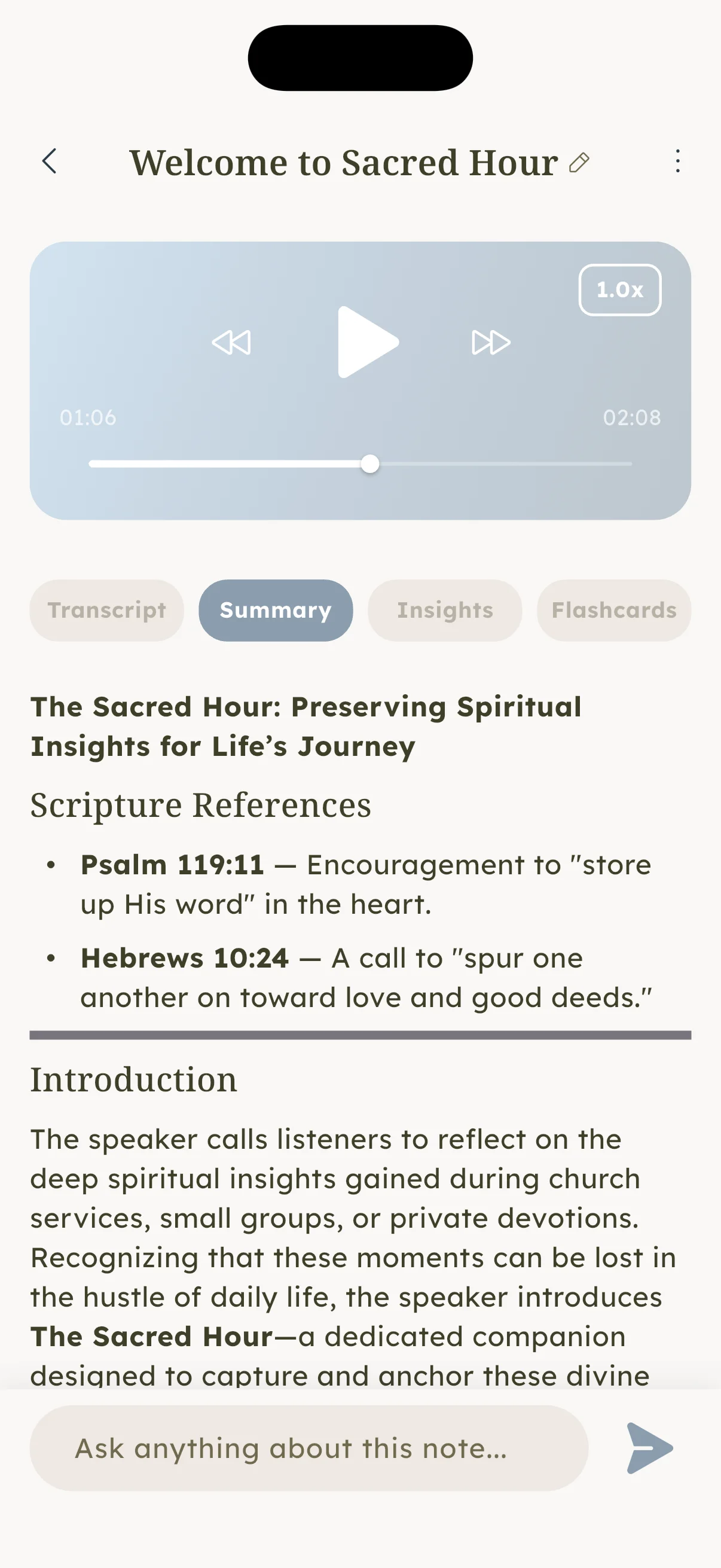
Sacred Hour records or scans the sermon, pulls out a clean summary and the key verses, and turns them into review cards — so your template only has to hold the one idea that matters.



Method 3 — The one-line template, for the Sundays you're barely there
Nobody publishes this one, and it's the one I'd defend hardest.
Some weeks you're running on four hours of sleep, or you're grieving, or the toddler needs walking out at minute nine. On those Sundays the two-column template isn't discipline — it's a guarantee you'll write nothing at all, feel worse about it, and quietly stop bringing a notebook.
So the template shrinks to what you can actually do:
Date: __________  Passage: __________

The one thing I don't want to forget:
_________________________________________________________
That's it. One line. Not a compromise version of real notes — a different tool for a different day.
A template you'll use at twenty percent capacity beats a beautiful one you abandon in March. Sacred Hour has a whole mode built on that conviction, and this is the paper version of it.
Which sermon note template should you use?
| Two-column | SOAP | One-line | |
|---|---|---|---|
| Best for | Any sermon; the default | Verse-by-verse on one passage | Hard weeks, distraction, grief |
| Time in the service | Moderate | Moderate | Under a minute |
| Time after | 5 min (cues + summary) | Optional | None |
| Main strength | Forces a second pass | Forces application + prayer | You'll actually do it |
| Main weakness | Feels empty if you skip the review | Breaks on topical sermons | Captures one idea, no more |
If you genuinely can't decide: start with two-column. It survives every kind of sermon, and the review step is the one that does most of the work.
Actually printing them
These are plain text on purpose — no fonts to install, no file to lose. Paste any of the three into a blank document, push the line spacing to 1.5 or 2.0 so there's room to write, and print. Six or eight copies at a time, folded once, living permanently in the back of your Bible. The friction of finding a template on Sunday morning is what kills this habit far more often than the template itself.
If you'd rather write on a phone, the same shapes work in any notes app — just guard the encoding on purpose and type less than you comfortably could.
No template survives without a review
Worth saying plainly, because it's the step everyone drops: notes you never reopen are barely better than no notes. The template's structure is what makes the review fast, but the review is what makes the template worth filling in. Five minutes on Monday or Tuesday — reread the passage, look at your one action, ask whether you did it.
Now these Jews were more noble than those in Thessalonica; they received the word with all eagerness, examining the Scriptures daily to see if these things were so.
— Acts 17:11
Daily. Not once, on the way out of the building.
Common questions
Which sermon note template is best for beginners?
The two-column template. It works for every kind of sermon, the layout tells you exactly what goes where, and the empty left column and bottom strip prompt the review step without you having to remember it. Start there for a month before trying anything else.
Should I print a sermon note template or use my phone?
Either works — what matters is that you'll actually revisit it. Paper wins on the encoding side, because writing slowly forces you to summarise instead of transcribe. A phone wins on search and review, since notes from six months ago are findable in seconds. The trap with digital is speed: if you can type fast enough to transcribe, you've given back the advantage.
What if my pastor doesn't preach in clear points?
Use the two-column template and don't try to impose a structure that isn't there. Capture the two or three moments that actually land, then do the structuring yourself in the bottom strip afterwards — one summary sentence and one action. Reconstructing the shape yourself is better for memory than copying a shape you were handed.
How much should I actually write during a sermon?
Less than feels right. Half a page for most people: one big idea, two or three verses with a few words on why they're there, and one concrete action. If your notes fill more than a page you're probably transcribing, which is the exact habit that stops sermons sticking.
What to do this Sunday
Pick one. Not all three — one. Copy it into your notes app or print four sheets tonight and put them where you'll see them on the way out the door.
Then use that same template for four consecutive Sundays before you decide whether it works. Every note-taking system feels awkward at first, and switching after one week means you're forever evaluating formats instead of listening to sermons. Four weeks, one shape, and a five-minute review on Monday. That's the whole thing.


