
Why Your Mind Wanders During Prayer (And What Actually Helps)
Distraction during prayer isn't a discipline problem you can just try harder at — it's a design problem your phone is winning by default.
By Oleh · Maker of Sacred Hour

Your mind wanders during prayer mostly because of "attention residue" — the mental pull of the last app you checked doesn't switch off the moment you put the phone down. The fix isn't more willpower; it's removing the phone as a live option during that window, and giving your mind something small to anchor to instead.
You sit down to pray. Thirty seconds in, you're mentally drafting a reply to a text you read four minutes ago. This isn't a spiritual failing — it's a documented cognitive effect, and it's worth understanding before you try to fix it.
The real reason focus breaks down
Psychologists call it attention residue: part of your attention stays stuck on a previous task even after you've moved on. Checking your phone right before prayer — even "just for a second" — loads your mind with open loops it hasn't finished processing.
The term comes from organizational psychologist Sophie Leroy, who documented the effect in a 2009 study published in Organizational Behavior and Human Decision Processes. Her experiments had people switch from one task to another, and measured how much the first task kept dragging down performance on the second. The key finding: residue is worse, and lasts longer, when the first task was left unfinished rather than completed.
That detail matters more for a phone than almost anything else Leroy studied. A text thread, an email inbox, a group chat — these are never actually "finished" in the way a word puzzle in a lab experiment is. There's always one more reply possible, one more unread message coming. Checking your phone for "just a second" doesn't give your brain a completed task to file away — it hands it an open loop with no natural end, which is close to the worst-case condition for residue to form.
Scripture describes something similar in its own terms:
Set your minds on things above, not on earthly things.
— Colossians 3:2
That's not just poetic advice. It's a recognition that where your mind has just been shapes where it can go next.
What doesn't work
- Willing yourself to "just focus harder"
- Leaving the phone face-down on the table (still visible, still one glance away)
- Silent mode alone (buzzing isn't the only pull — visibility is)
What actually helps
- Remove the option, not just the notification. A phone that's physically inaccessible removes the micro-decision entirely.
- Give your mind a small, specific anchor — a single verse, a name, a breath count — rather than an open-ended "try to focus."
- Protect the same window daily. Consistency lowers the activation energy each time; a randomly-timed prayer habit never stops feeling effortful.
A simple before/after
| Without a blocked window | With a blocked window | |
|---|---|---|
| First distraction | Almost immediate | Rare — you'd have to choose to check |
| Mental effort required | High, every time | Eases as the habit sets in |
| What ends the session | A notification | You, on purpose |
Setting up a window that actually sticks
The mistake most people make isn't lack of willpower — it's trying to protect "whenever I get a moment" instead of a fixed slot. A boundary that moves every day never stops requiring a decision.
Three starting points work better than a blank schedule:
- Anchor it to something that already happens. Right after you wake up, right before lunch, right after the kids are down — not "sometime in the morning." The anchor does the remembering for you.
- Start with one window, not three. It's tempting to block mornings, midday, and evenings all at once. Pick the one that's actually failing right now and protect that first.
- Build in a real exception, not a loophole. If you use your phone for Scripture or notes during prayer, allow that specific app and block everything else — deciding this ahead of time is different from deciding it mid-session, which is where the willpower argument usually loses.
Sacred Hour ships with three default windows — Morning Prayer, Midday, and Evening Prayer — so you're not starting from a blank schedule. You can pause any of them for a single day when life genuinely gets in the way, without having to delete the habit to do it. That distinction matters: a pause you can undo removes the guilt that usually kills a habit after one missed day.
How to actually stop phone distractions during your devotions
Most advice on this stops at 'put your phone away,' which skips the part that actually matters: away has to mean genuinely inaccessible, not just out of your peripheral vision. A few concrete ways to get there:
- Block, don't just silence. Silent mode stops the buzz but not the pull — the phone is still one glance away, still holding whatever open loop you left in it. A scheduled block removes the phone as a live option entirely for that window.
- Set it up before the window starts, not during. Deciding to block an app right now is exactly the kind of in-session negotiation that loses. Schedule the window once, in advance, and let it run without a daily decision.
- Allow real exceptions on purpose. If you use your phone for Scripture or notes during prayer, whitelist that one app and block the rest — deciding this ahead of time, deliberately, is different from leaving every app reachable just in case.
- Physically separate it if blocking alone isn't enough. For some people, a locked app icon is still too tempting mid-residue. Leaving the phone in another room during the window removes the last just-checking impulse entirely.
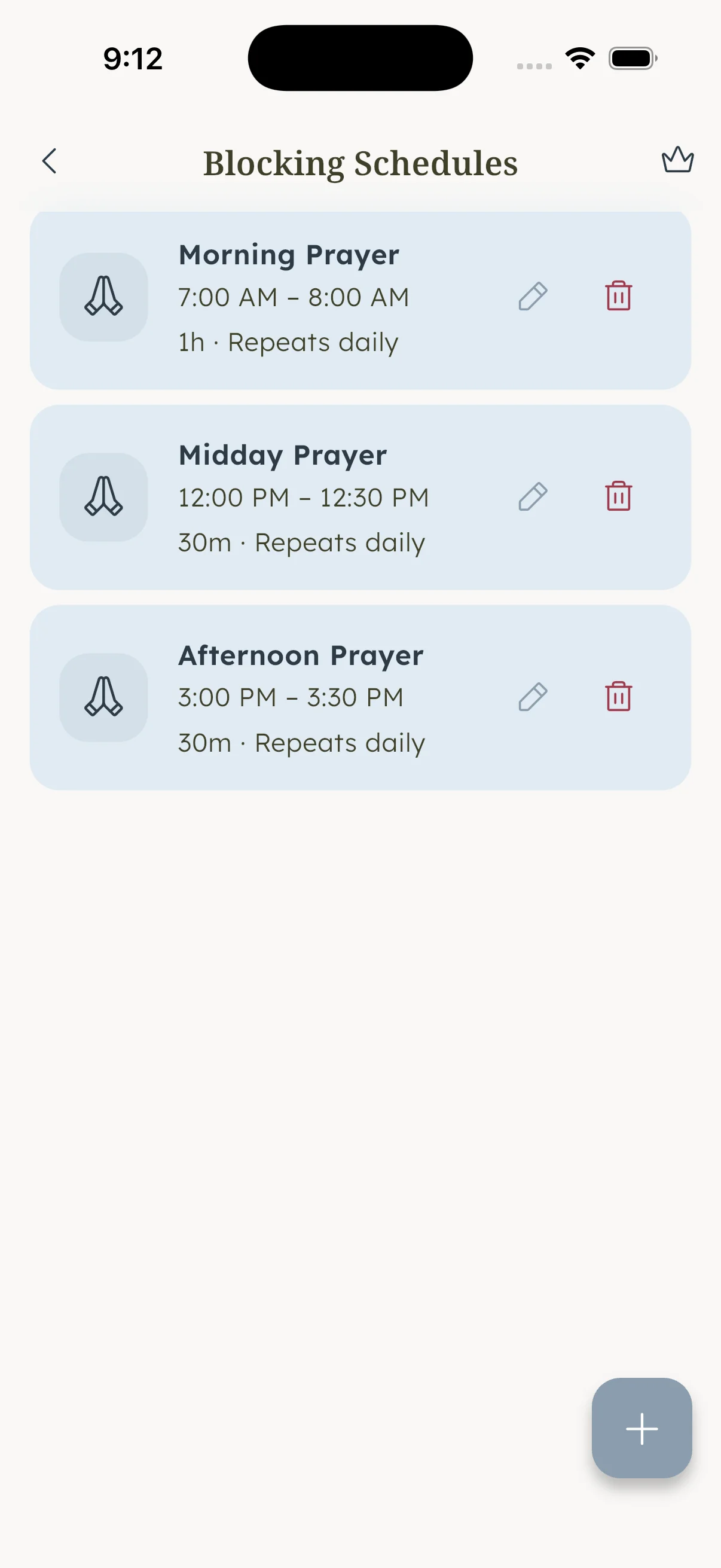
Let your phone hold the boundary for you
Sacred Hour blocks distracting apps during your prayer window, so staying present stops depending on willpower alone.



Common questions
Isn't blocking apps just another form of self-control I don't have?
Not quite — it moves the decision earlier. Instead of resisting a notification in the moment (hard), you make one decision ahead of time to schedule a blocked window (much easier), and let the app hold that boundary for you.
What if I need my phone for a Bible app or notes during prayer?
Build the exception in ahead of time rather than deciding mid-session — allow specific apps, or use one device for Scripture and notes and keep the rest blocked.
What's the difference between silencing my phone and blocking distracting apps?
Silencing stops the buzz but leaves everything just as reachable as before — the phone is still sitting there, still one glance away, still holding whatever you were reading before you sat down. Blocking removes the option itself for that window, so there's no small decision left to make in the moment. That's the actual mechanism, not just a stronger version of the same thing.
How long before this stops feeling effortful?
There's no fixed timeline, but the pattern is consistent: the friction is front-loaded. The first few sessions take the most deliberate effort; each repetition at the same time and place makes the next one easier, because you're no longer negotiating with yourself about whether to start.
What to do now
Pick one prayer window you already try to protect and fail at most often. Block it — even just that one — before you try to fix the rest of your day. The goal isn't a perfect schedule. It's removing the phone as a live option long enough for your attention to actually land somewhere else.


