
How to Protect Your Daily Quiet Time (Complete Guide)
Most quiet time advice tells you to try harder. The problem was never effort — it's that the time is left undefended, and everything louder wins by default.
By Oleh · Maker of Sacred Hour

Protecting your daily quiet time isn't about more willpower — it's about defending a fixed window before the day fills it in. Anchor the time to something that already happens, keep it short enough to actually repeat, remove your phone as a live option, and decide your exceptions in advance instead of mid-session. A quiet time app can hold the boundary for you so staying present stops depending on how you feel that morning.
You meant to have your quiet time this morning. You really did. Then you checked one notification, answered one message, remembered one thing you had to do — and the window closed before you ever opened your Bible. This isn't a discipline failure. It's what happens to any unguarded time slot: whatever is louder and more urgent moves in and takes it.
Here's the whole guide, start to finish — why quiet time keeps slipping, and a step-by-step way to actually defend it. Not with grit. With structure.
What "protecting" quiet time actually means
Most people think of quiet time as something they either have the discipline for or they don't. That framing is the problem. It treats a scheduling-and-environment issue as a character issue, and then loads you with guilt when the environment wins.
Protecting quiet time means three concrete things:
- A fixed slot, not "whenever I get a moment." A moving target requires a fresh decision every single day, and decisions are exactly what a tired or distracted person runs out of.
- A defended slot — the phone, the inbox, the to-do list, and the people around you all have a way of eating this window, and each one needs a specific answer.
- A repeatable slot — short and consistent beats long and occasional every time. A habit you keep at 60% is worth more than an ideal you abandon after four days.
Get those three right and "discipline" mostly takes care of itself. The goal isn't to become a more spiritual person by force. It's to build a small structure that a normal, busy, distractible person can actually keep.
Very early in the morning, while it was still dark, Jesus got up, left the house and went off to a solitary place, where he prayed.
— Mark 1:35
Notice the specifics in that verse. A time — very early. A place — solitary. Even Jesus protected the window with concrete conditions, not good intentions.
Why quiet time keeps slipping
Before the fixes, it helps to name what you're actually up against. Most quiet times don't die from one big failure. They erode from a handful of small, predictable pressures.
The phone is engineered to win
Your Bible app and your distraction live on the same device, and the distraction was built by teams optimizing for your attention. Opening your phone "just to read a Psalm" drops you into an environment where a dozen other things are one glance away — and each of those things is better at grabbing you than a quiet page of text is.
There's a documented cognitive effect underneath this. Organizational psychologist Sophie Leroy called it attention residue: after you switch away from a task, part of your mind stays stuck on it. Her 2009 research found the residue is worse when the first task was left unfinished — and a phone is nothing but unfinished loops. A half-read thread, an unanswered message, a feed with no bottom. Check it right before you pray and you've loaded your mind with exactly the kind of open loops that keep pulling.
The time is undefended
An unscheduled quiet time competes with everything else on equal footing, and it always loses, because everything else has a deadline and it doesn't. The Bible will still be there at noon. The email won't. So the email wins.
The plan is too big
The most common quiet-time resolution is wildly oversized: an hour a day, journaling, three chapters, a prayer list, worship. It feels holy on day one. By day four the sheer size of it becomes the reason to skip — because a busy morning can't absorb an hour, so it absorbs nothing.
One missed day becomes ten
Streak-based thinking turns a single miss into a collapse. You skip Tuesday, feel like you've "broken it," and the guilt makes Wednesday harder, not easier. The habit doesn't die from the missed day. It dies from what the missed day does to your motivation.
Step 1: Anchor it to something that already happens
The single highest-leverage move is to stop scheduling quiet time by the clock and start anchoring it to an existing event in your day.
"Sometime in the morning" requires you to remember and decide. "Right after I pour my first coffee" doesn't — the coffee does the remembering for you. This is habit-stacking, and it works because you're borrowing the reliability of a routine that's already automatic.
Good anchors share three traits: they happen every day, they happen at roughly the same time, and they have a clear finish that hands off cleanly to the next thing. A few that work well:
- Right after you wake up, before your feet hit the floor with the day's momentum.
- Right after your first coffee or tea is poured — the drink becomes the starting bell.
- Right after you drop the kids at school, in the quiet of the car before you drive off.
- Right before lunch, as a hard reset in the middle of the day.
- Right after you close your laptop at the end of the workday.
Pick one. Not five. You're protecting a single window first, and you're attaching it to a moment that already reliably happens.
Step 2: Pick a length you'll actually keep
Ambition kills more quiet times than laziness does. The instinct is to protect a big block. The better move is to protect a small one you can't talk yourself out of.
Start at ten minutes. Maybe five. The number should feel almost embarrassingly achievable — so achievable that "I'm too busy today" stops being believable even to you. Ten minutes fits into a bad morning. An hour doesn't, and a window that only survives good mornings isn't protected at all.
Length can grow later, on its own. Once the slot is a reliable fixture, most people naturally start lingering in it — because it's no longer a thing they have to start, just a thing they're already in. But that growth is a bonus, never the goal. The goal is a window short enough that you keep it on the day you least feel like it. That day is the whole point.
Step 3: Remove the phone as a live option
This is the step everyone underestimates, because everyone stops at "put your phone away." Away has to mean genuinely unreachable, not just out of your peripheral vision. A phone face-down on the same table is still one glance and one thumb away — and mid-residue, that's all it takes.
There's a real difference between silencing and blocking that's worth getting precise about, because they are not two strengths of the same thing:
- Silencing stops the buzz. The phone is still sitting there, still holding every open loop you left in it, still one unlock away. It removes the interruption but not the temptation.
- Blocking removes the option itself for that window. There's no in-the-moment decision left to lose, because the thing you'd decide about isn't available.
For a quiet time, blocking is the one you want, and the reason is subtle: it moves the hard decision earlier. Resisting a notification in the moment is genuinely difficult. Scheduling a blocked window once, in advance, is easy — and then the schedule holds the line so your tired 6 a.m. self doesn't have to.
Let your phone hold the boundary for you
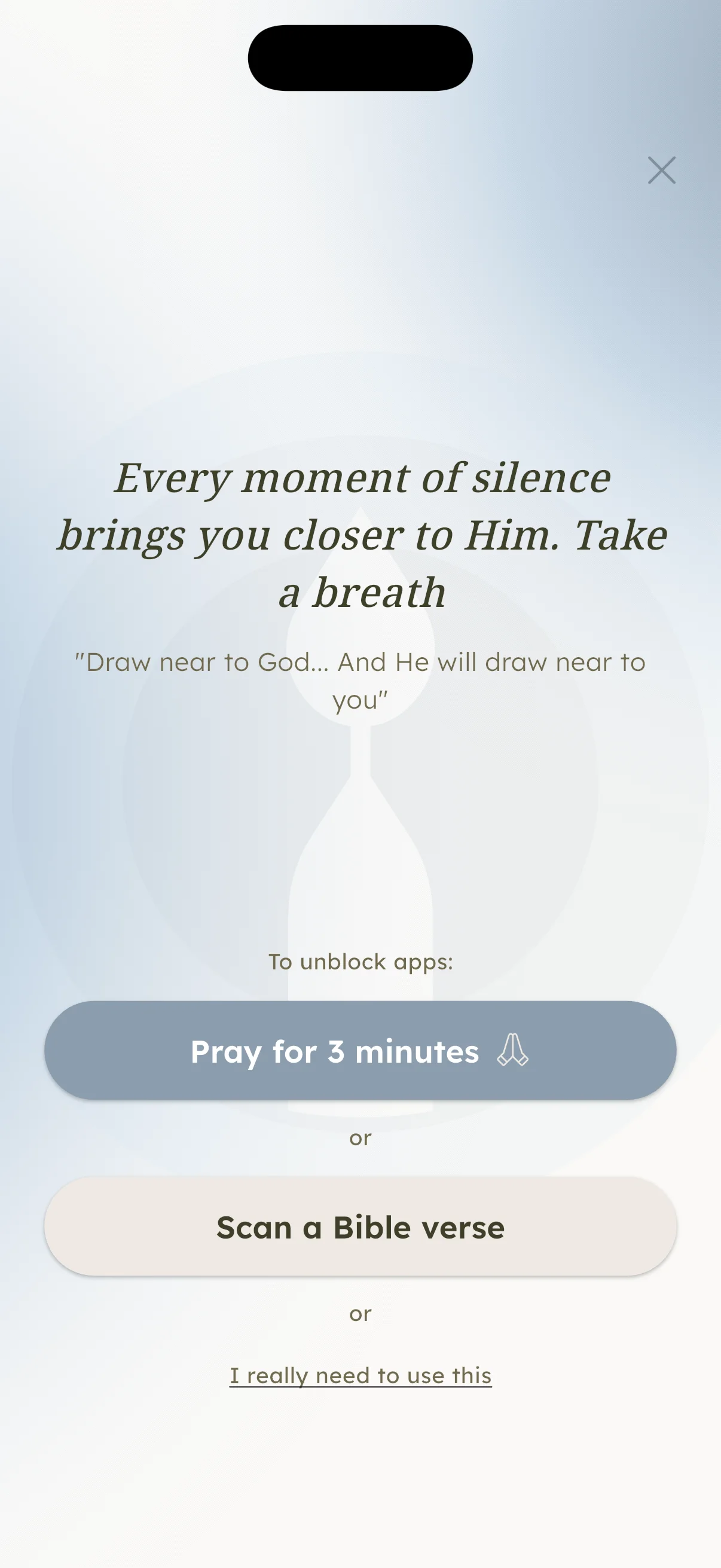
Sacred Hour blocks distracting apps during your quiet time window, so staying present stops depending on willpower alone.



If you use your phone for Scripture or notes, don't skip this step — handle it in the next one. And if blocking alone isn't enough for you, the oldest fix still works: put the phone in another room for the length of the window. Distance does what a locked screen sometimes can't.
Step 4: Give your mind something to anchor to
Removing the distraction leaves a gap, and a blank "now focus" instruction doesn't fill it well. Your mind, handed nothing specific, will manufacture its own distractions — tomorrow's meeting, that awkward text, the thing you forgot to buy.
So hand it something small and concrete instead:
- A single verse to sit with, rather than a whole chapter to get through. Depth beats distance here.
- One name you're praying for, held in mind, instead of an open-ended "pray about everything."
- A short written prompt — one question to ask the text, one line to journal — so the time has a shape and doesn't dissolve into staring.
The point isn't to fill every second. Silence is part of the practice, not a failure of it. The point is that when your attention drifts — and it will — you have a specific place to bring it back to, rather than an abstract instruction it can't obey.
Be still, and know that I am God.
— Psalm 46:10
That verse is a good anchor precisely because it's short. When the mind bolts, you come back to six words, not a paragraph.
Step 5: Build a real exception, not a loophole
Rigid rules break on contact with real life. A quiet-time system with no give will snap the first genuinely chaotic morning, and then take your motivation down with it. The fix is to design your exceptions on purpose, ahead of time, so a hard day bends the habit instead of breaking it.
Here's the distinction that matters. A loophole is decided in the moment — "I'll skip today, I'm too tired" — and it erodes the habit because the deciding is the hard part and you just lost it. An exception is decided in advance — "on travel days, my quiet time shrinks to two minutes and one verse in the airport" — and it protects the habit, because you've pre-committed to a smaller version instead of nothing.
Two exceptions worth building in from the start:
- A minimum version. Define the smallest quiet time that still counts — one verse, one breath, one sentence of prayer. On the worst days, you do the minimum, and the minimum keeps the chain of identity intact even when the full practice can't happen.
- A guilt-free pause. Some days you'll miss entirely. Decide now that a missed day is a missed day — not a broken streak, not evidence you're failing. You pick it back up tomorrow at the anchor, no penance required. The pause you can undo without shame is the thing that keeps one bad day from becoming a bad month.
This is where a grace-first mindset does real, practical work. Guilt is a terrible engine for a spiritual habit. It makes the next attempt heavier exactly when you need it lighter.
Step 6: Protect it from other people
The last threat isn't your phone or your schedule — it's the people who share your space. A partner with a question, a kid awake early, a roommate who wants to talk. None of them are doing anything wrong. But an undefended window has no way to say "not right now," so it gets absorbed.
A few ways to defend it socially, from gentlest to firmest:
- Tell the people you live with that this specific window is your quiet time. Most people respect a boundary they simply didn't know existed. The unspoken one gets crossed by accident.
- Choose a slot that's naturally protected — before the house wakes, or during a commute — so you're not relying on other people's restraint at all.
- Give kids a visible signal — a closed door, a specific chair, a small timer — that means "back in ten minutes," so even young ones learn the window has an edge.
The principle underneath all three: a boundary that's never communicated isn't a boundary. It's just a preference other people can't see.
Do you actually need a quiet time app?
You can protect quiet time with nothing but a paper Bible and a phone in another room. Plenty of people do. So be honest about what an app adds and what it doesn't.
An app earns its place when your main threat is your own device — when the phone is both your Bible and your biggest distraction, and "just leave it in another room" isn't practical because you read Scripture on it. In that specific bind, a tool that blocks everything else during your window while allowing what you need is doing something a paper Bible can't.
Here's a plain comparison of the common approaches:
| Approach | Protects the time | Handles the phone | Repeatable without willpower |
|---|---|---|---|
| Willpower alone | No | No | No |
| Phone in another room | Partly | Yes | Partly — but no Scripture on it |
| Silent / Do Not Disturb | No | Weakly | No |
| Scheduled app blocking | Yes | Yes | Yes |
Sacred Hour is built for that last row. It ships with three default windows — Morning Prayer, Midday, and Evening Prayer — so you're not starting from a blank schedule, and it blocks distracting apps during each one while letting you whitelist the tools you actually use to pray or read. When a genuinely hard day comes, you can pause a window for a single day without deleting the habit — the guilt-free exception from Step 5, built in.
The app isn't the point, though. The protected window is. If a drawer and a paper Bible get you there, use the drawer. Use whatever actually holds the line.
Putting it together: a first week
You don't build all six steps at once. You stack them, one at a time, so none of them requires heroic effort:
- Day 1: Pick your anchor (Step 1) and your length — start at ten minutes (Step 2). That's it. Don't touch the phone rules yet.
- Day 2–3: Keep the anchor. Now add the phone block for just that window (Step 3), and pick your one verse or name to sit with (Step 4).
- Day 4–5: Define your minimum version and your guilt-free pause (Step 5) before you need them — not in the middle of the first hard morning.
- Day 6–7: Tell the people you live with about the window (Step 6), and notice what's still eating the time. Adjust the anchor if it's fighting your actual mornings.
By the end of a week you're not relying on motivation. You're relying on a small structure that makes the right thing the easy thing.
Common questions
What's the best time of day for quiet time?
The best time is the one you'll actually keep, which almost always means the one attached to an existing daily anchor. Morning works for many people because the day hasn't filled up yet and willpower is freshest — but a protected midday or evening window beats a morning one you keep skipping. Consistency of slot matters more than which slot.
How long should my quiet time be?
Start shorter than feels impressive — ten minutes, or even five. A short window you keep every day builds the habit; a long one you keep occasionally doesn't. Length tends to grow on its own once the slot is a reliable fixture, but that growth should be a byproduct, never the target. Protect repeatability first.
How do I stop checking my phone during quiet time?
Don't rely on resisting the urge in the moment — that decision is the hard part, and it's the one you'll lose when you're tired. Move the decision earlier: schedule a blocked window in advance so the phone isn't a live option during that time, and whitelist only the specific app you need for Scripture or notes. If blocking isn't enough, put the phone in another room for the length of the window.
What if I miss a day?
A missed day is a missed day — not a broken streak or proof you're failing. Decide that in advance so the guilt of one miss doesn't sink the next attempt. Pick it back up at your anchor tomorrow. Habits survive missed days; they rarely survive the shame spiral that streak-thinking attaches to them.
Do I need a special app to protect quiet time?
Not necessarily. If leaving your phone in another room is practical, a paper Bible and a closed door will do. An app earns its place mainly when your phone is both your Bible and your biggest distraction — then a tool that blocks everything else during your window while allowing what you need is doing something distance alone can't.
What to do now
Don't try to build the whole system today. Do one thing: pick your anchor and your ten minutes, and protect that single window tomorrow morning. Block the phone for just those ten minutes, sit with one verse, and let everything else wait.
You're not trying to become a more disciplined person by force. You're building a small, defended slot you can keep on the day you least feel like it — because that's the day the whole thing is for.


